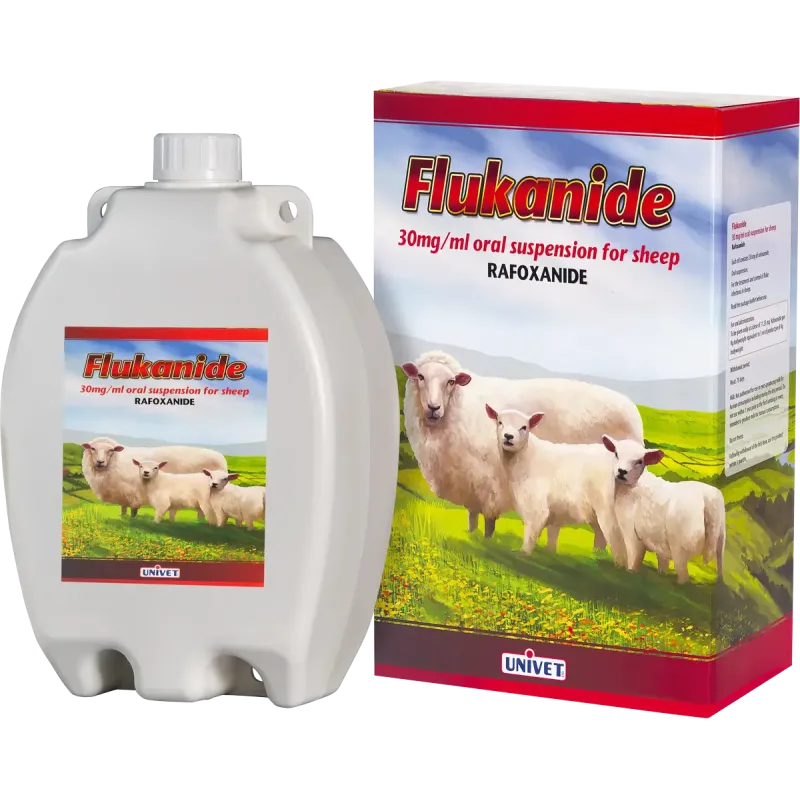
Flukanide fluke drench for sheep
- Product Code: Flukanide 5 Litre
- Availability: Pre-Order
Inc Vat: £108.00
- Ex Tax: £90.00
Graham Shepherd MRCVS will call you before dispatch to ensure this is the most applicable product for your sheep.
Flukanide is an innovative oral suspension containing 3% Rafoxanide, specifically formulated to combat liver fluke infections in sheep.
IT IS TO BE USED AS PART OF A FLOCK HEALTH PLAN AND WITH DUE REGARD TO SCOPS GUIDELINES. IF IN ANY DOUBT CONSULT YOUR VET.
Indications for use for each target species For the treatment of liver fluke (Fasciola hepatica) infections (6-8 week immature and adult)'
To be given orally at a dose of 11.25 mg Rafoxanide per kg bodyweight equivalent to 3 ml of product per 8 kg bodyweight == 15ml per 40 kg liveweight.
Meat withdrawl period is 78 days.
--------------------------------------------------------------------------------------------------------------------------------------
Full data sheet - check for any update in the datasheet supplied with the product-
Revised: March 2026 AN: 04240/2024
Page 1 of 5 SUMMARY OF PRODUCT CHARACTERISTICS
1. NAME OF THE VETERINARY MEDICINAL PRODUCT Flukanide 30 mg/ml oral suspension for sheep
2. QUALITATIVE AND QUANTITATIVE COMPOSITION Each ml contains: Active substance: Rafoxanide 30.00 mg Excipients: Qualitative composition of excipients and other constituents Quantitative composition if that information is essential for proper administration of the veterinary medicinal product Tartrazine yellow (E102) 0.07 mg Propyl parahydroxybenzoate (E216) 0.20 mg Methyl parahydroxybenzoate (E218) 2.00 mg Xanthan gum Simethicone emulsion Polysorbate 20 Propylene glycol Colloidal anhydrous silica Citric acid monohydrate Purified water A yellow suspension.
3. CLINICAL INFORMATION 3.1 Target species Sheep. 3.2 Indications for use for each target species For the treatment of liver fluke (Fasciola hepatica) infections (6-8 week immature and adult)' 3.3 Contraindications Do not use in cases of hypersensitivity to the active substance or to any of the excipients. Revised: March 2026 AN: 04240/2024 Page 2 of 5 3.4 Special warnings Unnecessary use of antiparasitics or use deviating from the instructions given in the SPC may increase the resistance selection pressure and lead to reduced efficacy. The decision to use the product should be based on confirmation of the parasitic species and burden, or of the risk of infection based on its epidemiological features, for each individual flock. Repeated use for an extended period, particularly when using the same class of substances, increases the risk of resistance development. Within a flock, maintenance of susceptible refugia is essential to reduce that risk. Systematically applied interval-based treatment and treatment of a whole flock should be avoided. Instead, if feasible, only selected individual animals or subgroups should be treated (targeted selective treatment). This should be combined with appropriate husbandry and pasture management measures. Guidance for each specific flock should be sought from the responsible veterinarian. Resistance to rafoxanide has been reported in immature 6-week-old Fasciola hepatica in artificially infected sheep in Australia (1989). In the study, two isolates of Fasciola hepatica that were resistant to rafoxanide were also resistant to closantel (another salicylanilide), indicating possible side resistance. However, the fluke isolates resistant to rafoxanide and closantel did not demonstrate side resistance to the salicylanilide oxyclozanide. Suspected clinical cases of resistance to anthelmintics should be further investigated using appropriate tests (e.g. Faecal Egg Count Reduction Test). Where the results of the tests strongly suggest resistance to a particular anthelmintic, an anthelmintic belonging to another pharmacological class and having a different mode of action should be used. 3.5 Special precautions for use Special precautions for safe use in the target species: When a dosing gun is used to administer the product, care must be taken to avoid damage to the pharyngeal region. Special precautions to be taken by the person administering the veterinary medicinal product to animals: This product may be irritating to skin and eyes or cause hypersensitivity. People with known hypersensitivity to rafoxanide or any of the listed excipients should avoid contact with the product. Wear nitrile rubber gloves when applying the product. Do not eat, drink, or smoke while handling the product. If accidental contact with the skin or eyes occurs, wash off any skin contamination with soap and water immediately. Rinse the affected eyes thoroughly with clean, fresh water. Remove and wash any contaminated clothing immediately. Wash hands after use. Special precautions for the protection of the environment: Rafoxanide is very toxic to dung insects. Long term effects on dung insects caused by continuous or repeated use cannot be excluded. Therefore, the product must only be administered once per year to affected animals only. Revised: March 2026 AN: 04240/2024 Page 3 of 5 3.6 Adverse events None. Reporting adverse events is important. It allows continuous safety monitoring of a veterinary medicinal product. Reports should be sent, preferably via a veterinarian, to either the marketing authorisation holder or the national competent authority via the national reporting system. See the package leaflet for respective contact details. 3.7 Use during pregnancy, lactation or lay Pregnancy and lactation: Can be used during pregnancy. 3.8 Interaction with other medicinal products and other forms of interaction None known. 3.9 Administration routes and dosage For single oral administration. To be given orally at a dose of 11.25 mg rafoxanide per kg bodyweight equivalent to 3 ml of product per 8 kg bodyweight. Accuracy of the dosing device should be checked. Underdosing could result in ineffective use and may favour resistance development. To ensure a correct dosage, body weight should be determined as accurately as possible. If animals are to be treated collectively, reasonably homogeneous groups should be set up, and all animals of a group should be dosed at the rate corresponding to the heaviest one. The timing for treatment should be based on epidemiological factors and farm history, and where appropriate, supported by diagnostic testing, and should be customised for each individual farm. As with other anthelmintics, veterinary advice should be sought on appropriate dosing programmes and stock management to achieve adequate parasite control and reduce the likelihood of resistance developing. 3.10 Symptoms of overdose (and where applicable, emergency procedures and antidotes) No specific signs. 3.11 Special restrictions for use and special conditions for use, including restrictions on the use of antimicrobial and antiparasitic veterinary medicinal products in order to limit the risk of development of resistance Not applicable. Revised: March 2026 AN: 04240/2024 Page 4 of 5 3.12 Withdrawal periods Meat: 78 days. Milk: Not authorised for use in ewes producing milk for human consumption including during the dry period. Do not use within 1 year prior to the first lambing in ewes intended to produce milk for human consumption.
4. PHARMACOLOGICAL INFORMATION 4.1 ATCvet code: QP52AG05. 4.2 Pharmacodynamics The product contains the active ingredient rafoxanide, a halogenated salicylanilide. Its principal use is as a flukicide against 6-8 week immature and mature F. hepatica. The product acts by uncoupling oxidative phosphorylation. Liver flukes treated in vivo or in vitro with rafoxanide show indirect evidence of uncoupling, including reduced ATP levels, decreased glycogen content and accumulation of succinate. This results in paralysis and death of the fluke. The product also binds strongly to plasma proteins and is inactive until ingested by the parasite and separated from the plasma albumin by digestion. For this reason, rafoxanide does not affect the host’s mitochondria in vivo. 4.3 Pharmacokinetics Halogenated salicylanilides are strongly bound to plasma proteins. After oral administration of the product rafoxanide is slowly absorbed reaching peak plasma concentrations approximately 2 days post treatment and its elimination half-life is approximately 22 days. Environmental properties Rafoxanide is very persistent in soils.
5. PHARMACEUTICAL PARTICULARS 5.1 Major incompatibilities None known. 5.2 Shelf life Shelf life of the veterinary medicinal product as packaged for sale: 36 months. Following withdrawal of the first dose, use the product within 3 months. 5.3. Special precautions for storage Do not freeze. 5.4 Nature and composition of immediate packaging 1, 2.5 and 5 litre high density polyethylene (HDPE) white containers with 38 mm white wadded polypropylene caps. Revised: March 2026 AN: 04240/2024 Page 5 of 5 This product may be marketed with or without an outer carton. Not all pack sizes may be marketed. 5.5 Special precautions for the disposal of unused veterinary medicinal product or waste materials derived from the use of such products Medicines should not be disposed of via wastewater. Use take-back schemes for the disposal of any unused veterinary medicinal product or waste materials derived thereof in accordance with local requirements and with any national collection systems applicable to the veterinary medicinal product concerned. Rafoxanide should not enter water courses as this may be dangerous for fish and other aquatic organisms.
6. NAME OF THE MARKETING AUTHORISATION HOLDER Univet Limited
7. MARKETING AUTHORISATION NUMBER Vm 05150/4009
8. DATE OF FIRST AUTHORISATION 19 April 2023
9. DATE OF THE LAST REVISION OF THE SUMMARY OF THE PRODUCT CHARACTERISTICS March 2026 10. CLASSIFICATION OF VETERINARY MEDICINAL PRODUCT Veterinary medicinal product subject to prescription. Find more product information by searching for the ‘Product Information Database’ on www.gov.uk. Approved: 18 March 2026
Related Products

TK Double D Gel Hoof Spray - 500 ml & 5 Litre refill

TK Double D intensive footbath for cattle & sheep (use at 2%) 25 kg.